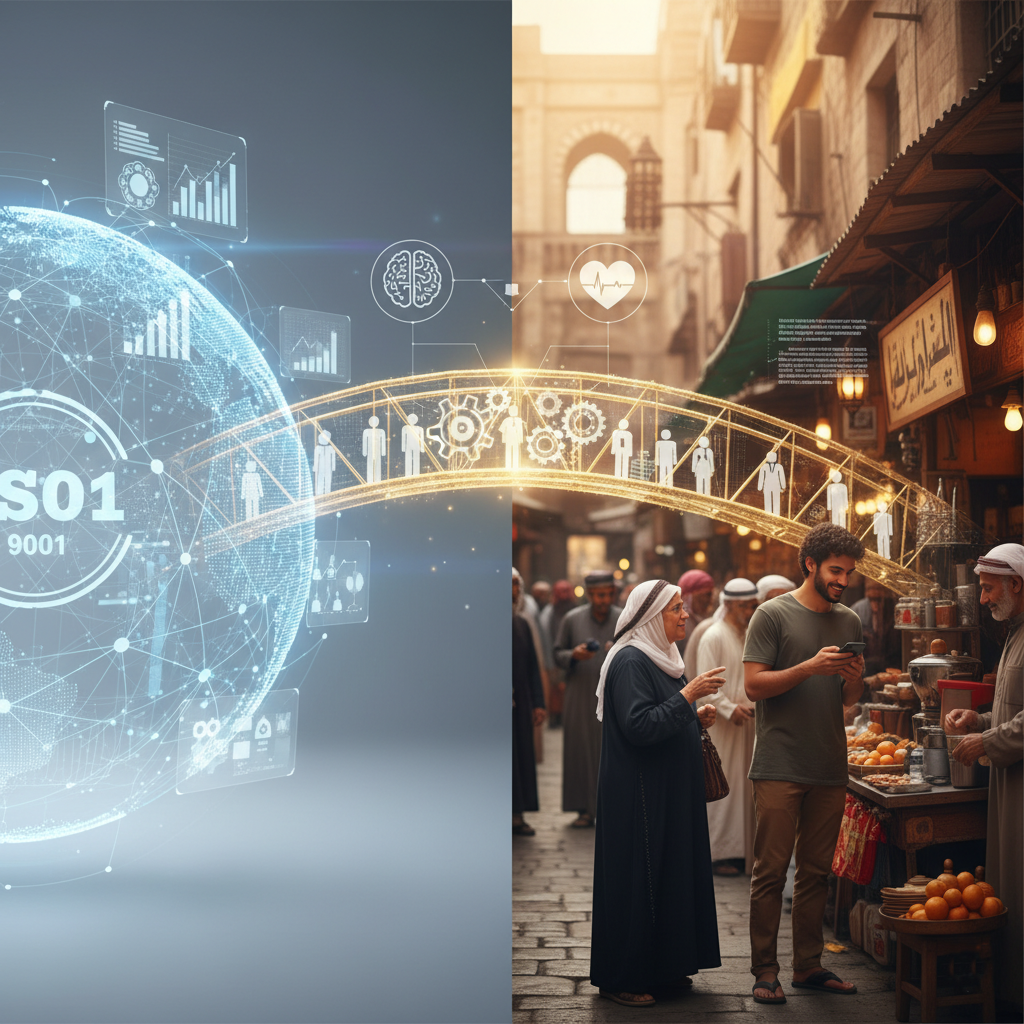
Bridging Global Standards and Local Realities in Service Design
Global service standards like ISO 9001, ITIL, and the EFQM Model have long been positioned as the blueprint for organizational excellence. They promise consistency, quality assurance, and international credibility — and for many companies, adopting these frameworks signals maturity and global competitiveness.
But real life isn’t lived inside a framework.
When organizations try to impose globally standardized processes onto markets with unique cultural, behavioral, and infrastructural realities, the outcome isn’t guaranteed success. In fact, when global ambition overlooks local nuance, it often leads to customer dissatisfaction, operational friction, and financial losses.
Modern service design succeeds only when global knowledge is paired with local intelligence. And few stories illustrate this better than the cautionary tale of a multinational telecom company that learned this lesson the hard way.
Table of Contents
The Parable of a Telecom Giant and the Local Disconnect
A multinational telecom operator recently embarked on a major transformation. The leadership decided to roll out a unified, digital-first customer support system across all regions—strictly aligned with an efficiency-driven ISO framework.
Their objective was clear: reduce service costs globally by moving 80% of interactions to AI chatbots and self-service portals. To achieve this, they mandated that customers must complete three automated self-service attempts before reaching a human agent.
The plan looked perfect—on paper.
When Global Meets Local: The Market of “Khorasan”
The new system was launched in a fast-growing market known as “Khorasan.” This region was unique—rich in cultural traditions, with a high respect for personal relationships and significant variations in digital literacy between urban and rural populations.
While the framework was globally efficient, locally it collided with three core realities:
Cultural Value of Dialogue: Customers saw service interactions as personal exchanges rooted in trust. The chatbot-only approach felt dismissive and disrespectful.
Generational Gap: Many high-value customers were older and preferred speaking with trusted representatives rather than navigating automated portals.
Infrastructure Limitations: The digital system relied on strong internet access—but many users faced connectivity issues, making self-service impossible when it was needed most.
The Disaster: Compliance Without Context
The local team, under pressure to maintain compliance, followed headquarters’ directives without adaptation. The results were severe:
Customer Effort Score (CES) skyrocketed as users struggled through chatbot loops.
Resolution Time (TTR) increased from 15 minutes to over an hour.
Net Promoter Score (NPS) collapsed as customers felt ignored and disrespected.
Employee Burnout rose sharply due to handling frustrated clients.
Within months, the company began losing market share. In relationship-driven cultures, negative word-of-mouth spreads fast—and that became the company’s biggest liability.
Media portrayed the brand as “cold” and “disconnected.” Customer acquisition slowed.
Long-term loss
Operational Costs
Call center attrition hit 50%; recruitment and training surged.
$3 million+
Regulatory Penalties
Local service response standards were breached.
$5 million
The Solution: Service Design as the Translation Layer
Modern service design is not about rejecting global standards—it’s about interpreting them meaningfully for each local market.
The key is to translate global frameworks into experiences that feel natural, culturally aligned, and emotionally resonant. It’s the art of upholding global excellence while honoring local context.
Our Approach: Contextualizing Excellence
At the Center for Service Quality Enhancement (CSQE), we help organizations bridge this gap through thoughtful, research-driven service design. Our approach ensures that operational excellence doesn’t come at the cost of cultural relevance.
Cultural Probing & Ethnography
We go beyond surveys—conducting in-depth fieldwork to understand local behaviors, values, and pain points. These insights reveal non-negotiables that shape how customers experience trust, care, and satisfaction.
Flexible Framework Adaptation
We align global standards like ISO or EFQM with local service journeys. The result: measurable outcomes (like faster resolution) delivered through locally optimized processes (like live agent support for seniors).
Pilot, Test, and Iterate
Instead of one-size-fits-all rollouts, we design small-scale pilots. These allow us to test, refine, and validate service blueprints—ensuring both efficiency and emotional connection before full implementation.
The world doesn’t need more perfectly standardized systems—it needs service designs that feel human in every market they touch.
If your global strategy isn’t producing local customer loyalty, it’s time to rethink your design approach.
Let CSQE help you translate global excellence into local success.